Studio
AI production system for animated series - consistency as a product problem
- Product
- Brand
- AI
- Direction
Overview
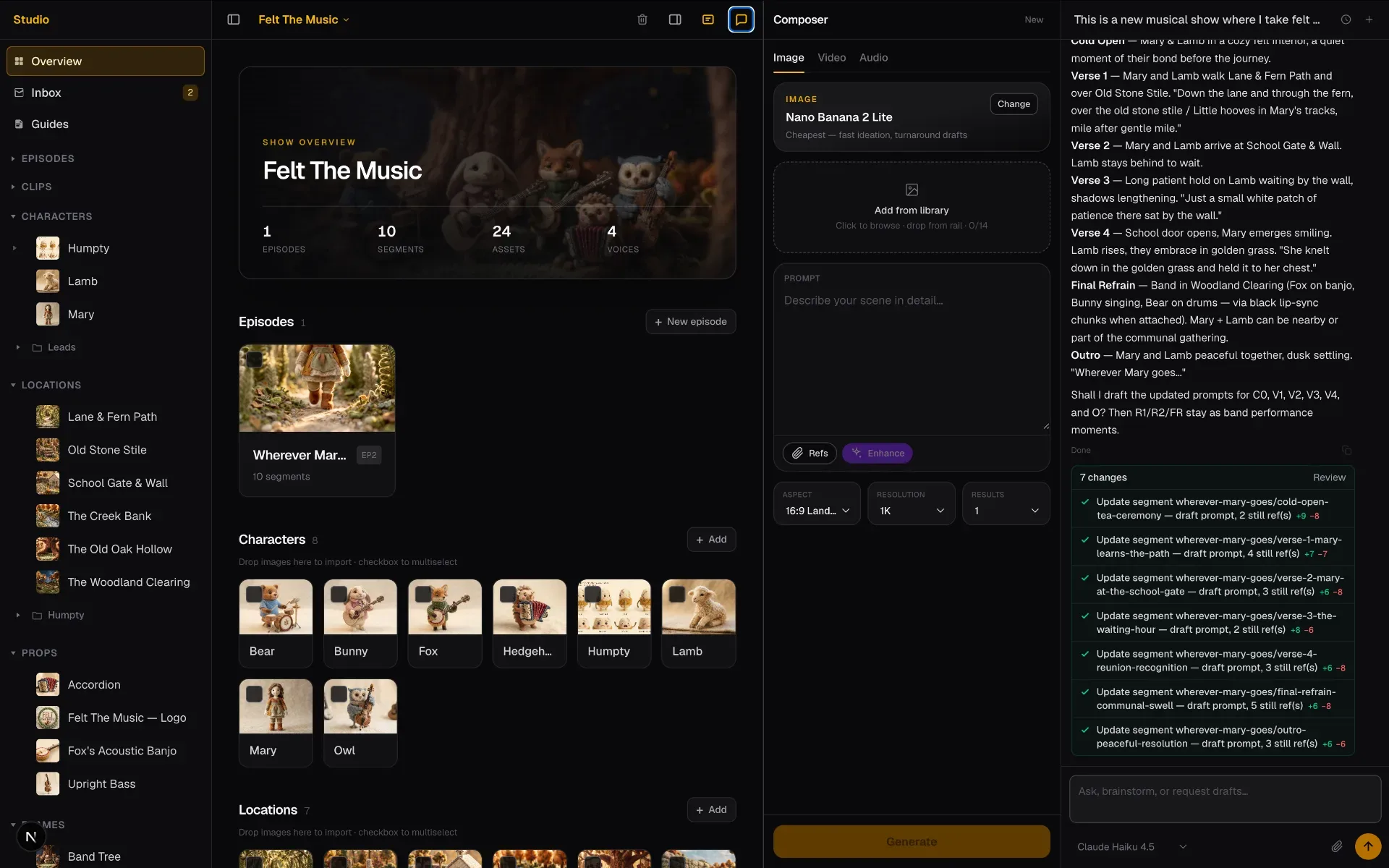
Studio is a production workspace for DNA-driven AI animation - not a timeline editor. I cut a finished one-minute clip from about eight hours of thrash down to roughly two by treating cast continuity as a product problem, not a prompting habit.
I designed and built it end to end (Next.js, Runware for Nano Banana / Seedance, agent chat) while directing original series work through it - including Felt The Music, visible in the workspace screenshot.
Problem
Saving and reusing good prompts helps a little, then falls apart when the same character needs a different outfit, or the same location at night. A template doesn’t carry visual identity. Fal playgrounds made the gap obvious: every one-off restarted from scratch.
For a series you need characters and locations as entities with variants, a composer that locks references, and a path from cheap drafts to final clips - without reinventing the cast every take.
Product design
Landed on entities with variants as first-class assets. Characters, locations, and props sit in the library; Fred can have a default look and a cowboy variant. Drop him into Composer, switch the variant - don’t hunt for the still. Character sheets lock the look.
Studio stays hands-on for building: pick assets, send to Composer, generate. The agent sits beside that path for questions, planning, and drafting - “group this cast at the park,” or “Fred skydiving with a parachute” - with the same library and show bible underneath. Two models, one ecosystem.
- Hierarchy: Episodes · Clips · Characters · Locations · Props · Frames - same underlying asset model, separated to lower friction when assembling a clip
- Soft nested folders (leads vs side characters, Episode 1 vs Episode 2 locations)
- Reference slots so Seedance clips lock to approved stills, not free-floating prompts
- Model tiers for prototype → production; agent ops are structured and reversible
Art direction
Taste lives as data: show DNA and asset DNA are the style bible. Felt The Music keeps a coherent felted-character world across the library - direction becomes a system you browse and reuse, not only a prompt skill.
Outcome & honesty
An internal tool I’m running to ship a YouTube series faster. Validation is thin on purpose: it’s me grinding the workflow to get episodes out. The IA is the risk I’d watch closest with a new user - if they hesitate or take a wrong path, the fix is restructuring, not hover tips.